












If you are comparing quotes for an FUE Hair Transplant, the number that matters most is usually the graft count, not the technique name. This guide explains what a graft is and how a specialist estimates the number you need. It also covers why your donor supply sets a firm limit, and how to compare prices from clinics on a like-for-like basis.
Approximate graft ranges by Norwood stage (guide only)
| Stage | Typical area treated | Approximate grafts |
|---|---|---|
| Norwood 2–3 | Temples and hairline | 1,000–2,500 |
| Norwood 3 vertex–4 | Hairline, front and early crown | 2,000–3,500 |
| Norwood 5 | Front, mid-scalp and crown | 3,000–4,500 |
| Norwood 6–7 | Extensive loss; often staged or partial | 4,000–6,000+, donor permitting |
Typical figures at a glance
What is a hair graft, and how many hairs does it hold?
A Graft is a small unit of tissue taken from the Donor area, usually the back and sides of the scalp. Each graft contains a Follicular unit, which is a natural group of hair follicles. Most units hold one to four hairs, and the average across a scalp is often around two hairs per graft.
This difference matters when you read quotes. A clinic that quotes grafts is giving you a different figure from one that quotes hairs. 3,000 grafts may mean roughly 6,000–7,500 hairs, depending on your natural unit sizes. Always check which unit a quote uses.
- Single-hair grafts are usually placed at the front edge to create a soft, natural-looking hairline.
- Two- and three-hair grafts build density behind the hairline and through the mid-scalp.
- Larger units are often reserved for areas where you need the most coverage, such as the Crown (vertex).
How a specialist estimates the grafts you need
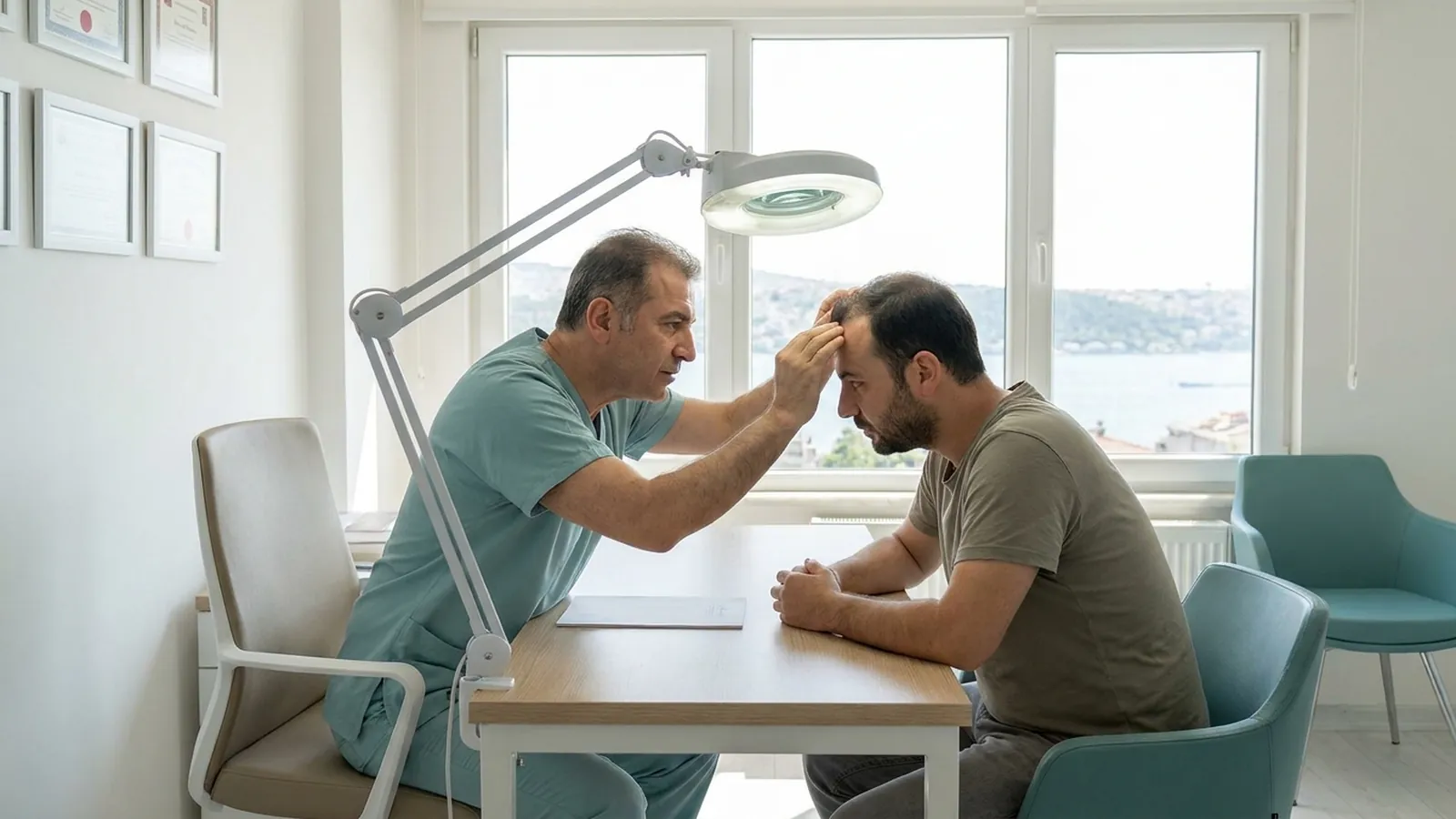
There is no single chart that gives your exact number. A specialist builds the estimate during consultation, often starting with photographs and confirming in person. Men's loss is usually graded on the Norwood scale and women's on the Ludwig scale, but the grade is only a starting point.
What the assessment usually covers
- Map the recipient areaThe specialist measures the Recipient area, meaning the zones that need coverage, and agrees priorities with you, such as the hairline first and the crown later.
- Agree the hairline designHairline design sets how low and how dense the front will be. A lower, straighter line needs more grafts and uses more of your donor reserve.
- Assess hair characteristicsThick, wavy or curly hair, and a low contrast between hair and skin colour, can give more visual coverage per graft than fine, straight hair.
- Measure donor densityThe number of follicular units per square centimetre and the size of the safe donor zone show how many grafts can be taken without visible thinning.
- Consider future lossYour age, family history and how stable your loss is all shape how much the specialist leaves in reserve.
Donor area limits: why more grafts is not always better
Your donor supply is finite. Over a lifetime, many people have roughly 4,000–7,000 grafts that can be taken safely from the scalp, and some have fewer. Once follicles are moved, they do not regrow in the donor area.
A very high graft count in one session can look attractive on a quote. If too many grafts are taken, however, the donor area may look patchy or thin. That leaves little room for Revision surgery or for treating loss that appears later. A realistic plan spends grafts where they make the biggest visible difference and keeps a reserve.
A transplant may not suit everyone. People with very low donor density, loss that is still progressing rapidly, unrealistic density expectations or certain uncontrolled medical conditions may be advised to wait or consider other options. Non-surgical treatments such as PRP Therapy can support existing hair in some people. It does not create new follicles, and results vary.
What determines the cost of a hair transplant in Istanbul
Price follows the plan more than the technique label. The graft count, the time needed in theatre and the size of the team drive most of the cost. Inclusions such as transfers, accommodation and aftercare make up much of the rest.
- Graft count and session length: more grafts mean longer extraction and placement time.
- Technique and tools: FUE (Follicular Unit Extraction), Sapphire FUE and DHI (Direct Hair Implantation) use different instruments and workflows.
- Who does what: the role of the specialist during extraction, channel opening and placement.
- Pre-operative tests and medication: blood tests, local anaesthesia and post-operative products.
- Travel package: transfers, hotel nights and interpreter support, if included.
- Aftercare and follow-up: written aftercare, the first wash and remote check-ins after you return home.
Technique names in brief
| Benefit | Limitation | |
|---|---|---|
| FUE Hair Transplant | Individual extraction leaves small dot scars rather than a linear scar. | It usually needs a shaved donor area and a long session for high graft counts. |
| Sapphire FUE Hair Transplant | Sapphire blades allow fine, precise recipient channels. | The blade does not increase your donor supply or the number of grafts you can have. |
| DHI Hair Transplant | Implanter pens give close control over angle and direction, often with less shaving. | It is usually slower per graft, which can limit the count possible in one session. |
Estecenter publishes euro price ranges quarterly and aims for transparent pricing with no hidden fees. Your final figure depends on the plan your specialist agrees with you before you travel.
How to compare quotes like for like
Many UK patients collect several quotes. They are only comparable when they describe the same thing. Before you compare prices, ask each clinic to confirm the points below in writing.
Questions to ask every clinic
| Item | What to confirm |
|---|---|
| Graft estimate | A number or narrow range in grafts, not hairs, based on your photos or examination |
| Areas treated | Hairline, mid-scalp, crown: which are included in this session |
| Donor plan | How many grafts will be left in reserve for the future |
| Team and roles | Who performs each stage of the procedure |
| Inclusions | Tests, medication, transfers, hotel, aftercare products and follow-up |
Get a realistic graft estimate
Send your photos for review, and a specialist will agree a plan and graft range with you before you travel. You receive written aftercare in your language and follow-up from home.

Frequently asked questions
How many grafts do I need for a hairline?
Can I have a second transplant later?
Is a higher graft count always better value?
Does the technique change how many grafts I can have?
Glossary
Key terms used in this article.
- Graft
- A graft is one follicular unit of scalp tissue that usually contains between one and four hairs, and clinics use graft counts to describe transplant plans. Learn more: Graft
- Crown
- The crown is the swirl-shaped area at the top back of the scalp where hair radiates outwards and where pattern baldness often thins. Learn more: Crown
- Mid-scalp
- The mid-scalp is the hair-bearing belt between the frontal hairline and crown whorl where graft angles and density shift most as surgeons link frontal tufts with vertex thinning. Learn more: Mid-scalp
- Follicular unit
- A follicular unit is the natural cluster of one to four hairs sharing a follicle opening, sebaceous gland, and tiny arrector muscle on the scalp. Learn more: Follicular unit
- Donor area
- The donor area is the occipital and lateral fringe of scalp where hair is genetically resistant to miniaturisation and is used as the source for transplantation. Learn more: Donor area
- Estimated graft requirement
- Estimated graft requirement is a working forecast of how many follicular units a surgeon thinks a defined recipient plan will consume, before numbers are finalised on the day. Learn more: Estimated graft requirement