












If you are comparing hair restoration options, you have likely come across two names again and again. Both DHI Hair Transplant and FUE Hair Transplant aim to move healthy follicles from a donor area to thinning zones, but they differ mainly in how the grafts are placed into the scalp. Understanding that difference helps you ask better questions during your consultation.
DHI vs FUE at a glance
| DHI | FUE | |
|---|---|---|
| Placement tool | Implanter pen (Choi) | Forceps into pre-made channels |
| Channel creation | Done during implantation | Separate earlier step |
| Shaving | Partial or minimal often possible | Usually fuller shaving |
| Typical fit | Hairline, focused density | Larger areas, high graft counts |
How FUE and DHI actually differ
In both approaches, individual follicular units are harvested one by one from the donor area, usually the back and sides of the scalp. The techniques diverge at the point of placement. In FUE (Follicular Unit Extraction), the surgeon first creates tiny recipient channels and then inserts the grafts. In DHI (Direct Hair Implantation), a specialised implanter pen opens the channel and places the graft in a single motion.
Because the pen controls the angle, depth and direction at the moment of implantation, DHI can give fine control over how each graft sits. FUE separates these steps, which some surgeons prefer for very large sessions. Variations such as Sapphire FUE Hair Transplant use sapphire blades to open the channels, and a Hybrid Hair Transplant may combine elements of both.
It is worth remembering that technique names describe a method, not a quality level. A carefully performed FUE and a carefully performed DHI can both produce natural coverage. The deciding factors are usually your pattern of loss, how much donor supply you have and what the surgeon is most experienced with.
Where each technique tends to fit
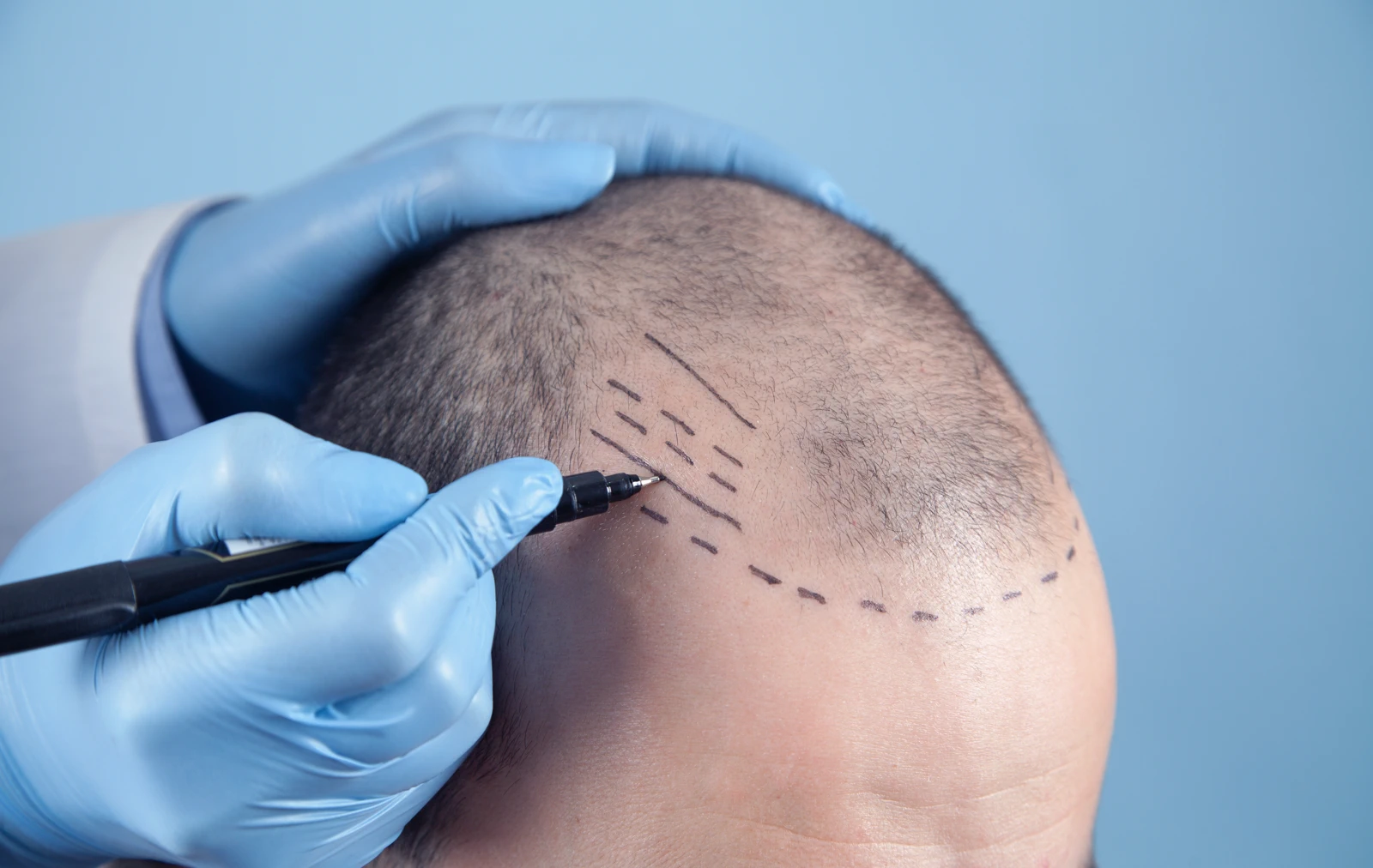
DHI is often chosen for detailed work around the Hairline design and for adding density to specific zones, because the implanter allows close, controlled placement. FUE is frequently used when a larger surface, such as the Crown (vertex), needs coverage and a high number of grafts is planned in one session.
Your pattern of loss also matters. The Norwood scale for men and the Ludwig scale for women help describe the extent of thinning, which influences how many grafts you may need and which approach suits your goals. The number of grafts itself is estimated during examination, and the figure can change once the surgeon assesses your donor area in person.
- Precise hairline or small, dense areas: DHI is commonly considered.
- Extensive balding or very high graft counts: FUE is often practical.
- Mixed goals: a hybrid approach may be discussed.
- Limited donor area: the surgeon weighs both options carefully.
Shaving, recovery and healing differences
A practical concern for many people is shaving. DHI can sometimes be performed with only partial shaving of the recipient area, which some patients find discreet. Full-shave FUE is often used for larger sessions. In both cases, the Donor area typically needs some trimming so the surgeon can harvest cleanly.
Early healing is broadly similar across both methods. Small crusts form around each Graft and usually settle over one to two weeks. Mild redness, swelling and temporary numbness are common in the first days. Some people experience Shock loss, a temporary shedding of existing or transplanted hairs, before regrowth begins over the following months.
What to expect (general ranges)
Questions to ask before deciding
Rather than choosing a technique in advance, it often helps to describe your goals and let the surgeon recommend an approach. Aftercare, including Washing Hair After Hair Transplant and follow-up treatments such as PRP Therapy or Mesotherapy, should also be part of the conversation so you know what the full plan involves.
Useful questions for your consultation
- Which technique suits my pattern?Ask how your Norwood or Ludwig stage affects the recommendation.
- How many grafts do I need?Request a realistic graft estimate and donor area assessment.
- How much will be shaved?Clarify whether partial-shave DHI is realistic for your case.
- What does recovery involve?Confirm timelines, aftercare and when results become visible.
Weighing the two approaches
Advantages
- DHI offers fine control over angle and density
- DHI may reduce shaving in some cases
- FUE is efficient for large sessions
- Both avoid a linear donor scar
Disadvantages
- DHI sessions can take longer per graft
- FUE large areas usually need full shaving
- Results depend heavily on surgeon skill
- Neither can promise a specific outcome
The right technique is the one that matches your goals, donor supply and pattern of loss, decided together with your surgeon.
Not sure which technique fits you?
Share your goals and photos with our team to receive a personalised assessment and graft estimate based on your examination.

Frequently asked questions
Is DHI better than FUE?
Does DHI require shaving?
Which technique gives higher density?
How long until I see results?
Glossary
Key terms used in this article.
- Donor area
- The band of hair at the back and sides that supplies the grafts. Learn more: Donor area
- Graft
- One follicular unit, moved from the donor area to the recipient area. Learn more: Graft
- FUE (Follicular Unit Extraction)
- Harvesting grafts one at a time with a small punch. Learn more: FUE (Follicular Unit Extraction)
- Follicular unit
- The natural grouping of one to four hairs that grow together. Learn more: Follicular unit
- DHI (Direct Hair Implantation)
- Placing grafts with an implanter pen, without pre-opened channels. Learn more: DHI (Direct Hair Implantation)
- Hairline design
- Where the new hairline is drawn, and at what angle. Learn more: Hairline design