

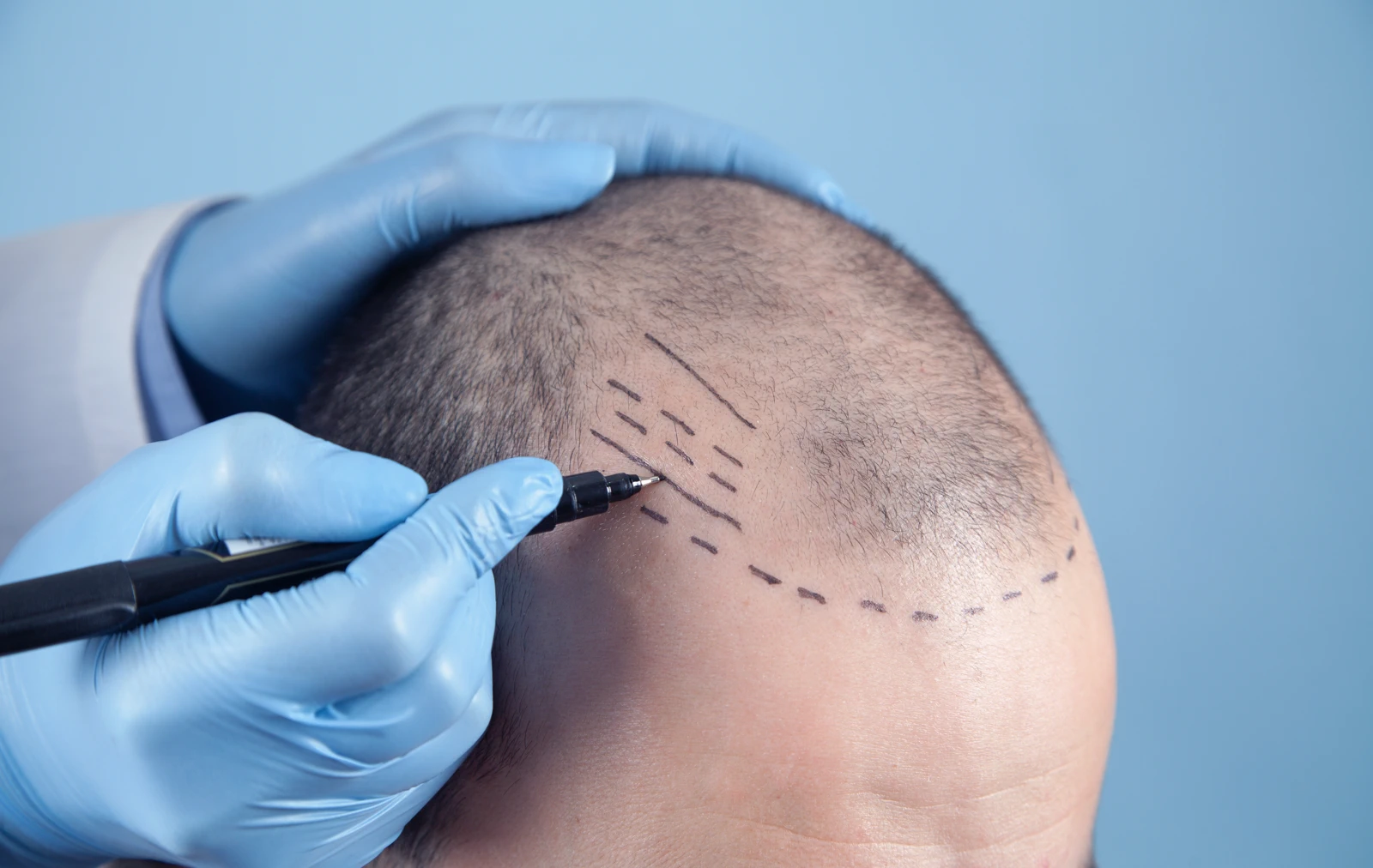





How old is your hairline?
Pick the picture that matches you and we will tell you the age that hairline usually belongs to. It is a bit of fun with a real number behind it: the projection underneath is the part worth taking seriously.

 Seven Norwood stages, with pictures rather than jargon
- Shows the rate, not just the stage — rate is what decides timing
- Nothing uploaded, nothing stored
Your hairline is about
—

This is a comparison against population averages, not a diagnosis. It cannot see your donor area, measure your density or tell the difference between pattern loss and six other things that thin hair. A trichoscopy appointment takes fifteen minutes and answers all of that properly.
What the number actually means
Male pattern hair loss follows a fairly predictable population curve. Most men are still Norwood 1 through their twenties, reach Norwood 2 somewhere in their thirties, and Norwood 3 around their late forties. After that it slows down for some people and does not for others.
Why the rate matters more than the stage
A Norwood 3 at 45 who got there over twenty years is a different patient from a Norwood 3 at 27 who got there in four. The first one can be transplanted now with a design that will still make sense in a decade. The second needs the loss stabilised with medication first, because a transplant into an actively receding area leaves a transplanted island surrounded by nothing.
That is the single most common mistake in hair transplant surgery, and it is a planning error rather than a surgical one. It is also the reason this tool asks how long it has been going on.
What this tool cannot see
It cannot see your donor area, which decides how much hair is available to move. It cannot measure density, which is how early loss is actually detected. And it cannot tell pattern loss apart from telogen effluvium, thyroid disease, iron deficiency or traction — all of which thin hair and none of which need surgery.
If the number surprised you, the next step is a measurement rather than another quiz.
Want the real number?
Send a few photographs from the front, top and back. You will get a Norwood stage from someone who does this all day, a donor assessment, and an honest answer about whether anything needs doing yet.